

Hiking & walking
Waterproof socks for hiking and walking
Every waterproof boot soaks through eventually. This is the layer still working when yours does, four hours into a wet day with eleven miles to go.
Product facts
- Waterproof layer
- Porelle® membrane
- Build
- Three layers
- Sizes
- UK 3 to 14
- Price
- From £20 a pair
The problem
Four ways a walk gets your feet wet
Only one of these is the thing boots are designed to stop. That’s why good boots and wet feet aren’t a contradiction.
-
Over the top
Wet grass, bracken and heather put water onto the boot from above, where the tongue and the laces are. Gaiters help. They don’t seal.
-
The boot soaks through
The outer fabric saturates, the boot stops breathing, and everything your foot produces stays inside. It isn’t leaking — it’s full. This is the four-hour problem.
-
Streams and bog
There’s a depth beyond which no footwear helps, and on wet British ground you meet it more often than the forecast suggests.
-
From the inside
Eight hours of walking produces a lot of moisture. Plenty of people with perfectly good boots finish the day damp anyway.
The waterproof layer sits inside the sock rather than inside the boot. That changes where the waterproof line is, and what happens when the boot gives up.
-
Your boot can be soaked and your foot dry
Once the waterproof layer is on your foot, a wet boot is uncomfortable rather than a disaster. You stop planning the route around the puddles.
-
They work with any boot, including a leaky one
Most people find waterproof socks because their boots have started letting water in. It’s the cheapest useful thing to try before spending two hundred pounds.
-
They aren’t a replacement for boots
Said plainly here as well as on the homepage. If your footwear is wrong for the ground, this won’t fix it. It solves wet, not grip or ankle support.
Blisters
What dry feet do and don’t prevent
Waterproof socks help with blisters. They don’t prevent them, and anyone telling you otherwise is selling you something.
Wet skin blisters more easily
Soft, wet skin gives up under friction much faster than dry skin. Keeping your feet dry removes one of the three things a blister needs, and that’s a genuine help.
Friction and fit still matter
The other two are pressure and movement. A boot that rubs will still rub. A sock that’s too small will still bunch up. No waterproof layer changes either.
Grit is the one nobody mentions
On wet ground, fine grit washes in over the top and sits under your foot. It’s abrasive against your skin and against the sock. Rinse both at the end of a wet day.
This is the question most sellers skip and where most returns come from. Waterproof socks are thicker than the sock you’re used to.
About the same as a mid-weight sock
If your boots are already snug with a thick walking sock, they’ll be tight with these. If you wear a thin liner under a thick sock, these replace both.
Between two sizes, go up
Going down grips your toes, which is uncomfortable over eight hours and hard on the waterproof layer. Foot length, not shoe size, sets the size.
Your laces will need adjusting
A thicker sock changes where a boot loads over the instep. Give the laces one honest adjustment on the first walk rather than deciding the fit is wrong.
Order
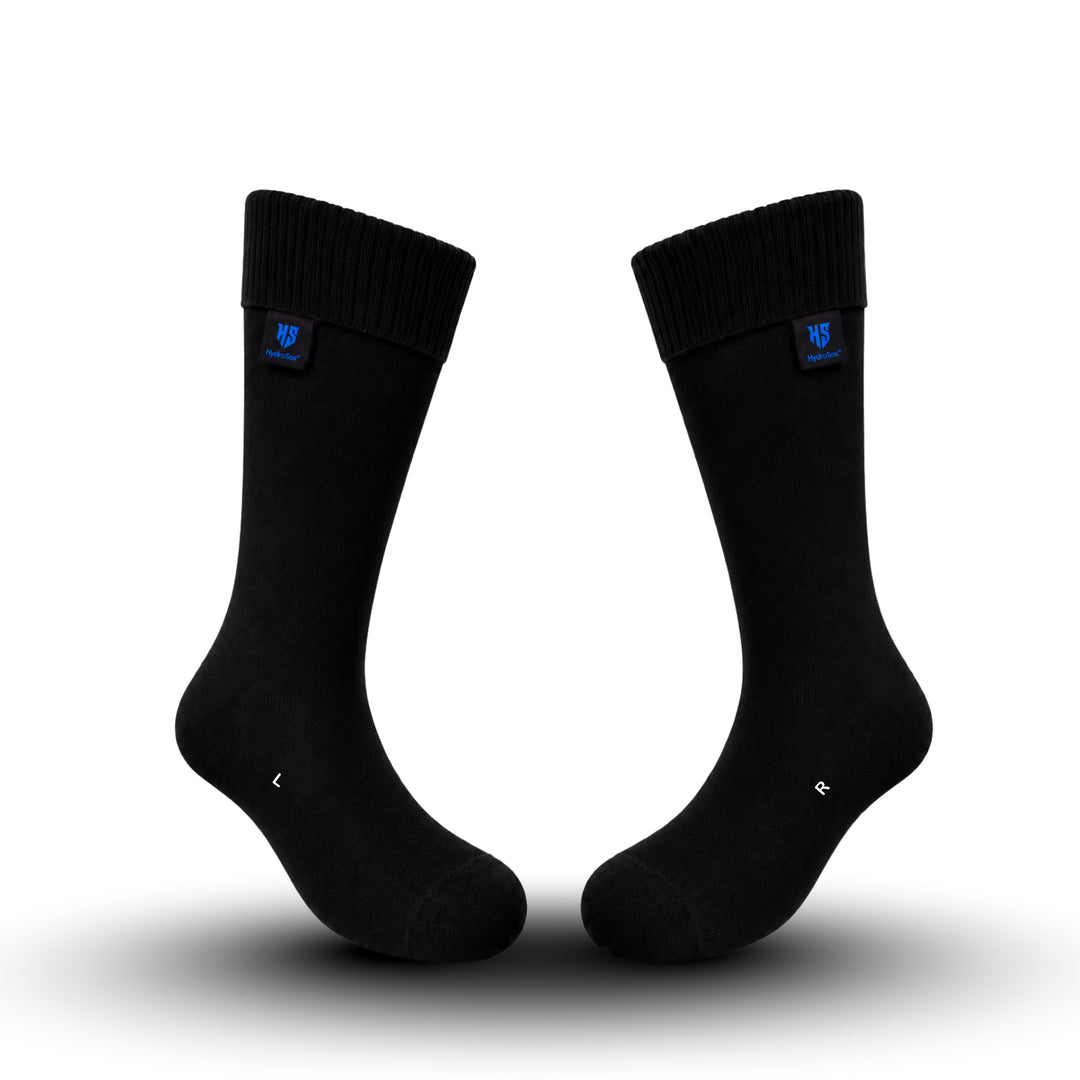
Choose your colour and size
One price, whichever page you came in on.
- Delivery
- Free UK delivery on two pairs or more
- Dispatch
- UK company, UK warehouse
- Checkout
- Guest — no account required
- Payment
- Visa · Mastercard · American Express · Apple Pay · Google Pay · Shop Pay
Questions
Common questions
Answered with the same facts as the rest of this page. If one of them contradicts something above, the answer above is the one that is wrong.
Something not here? Phone or email us
Are waterproof socks good for hiking?
Yes, especially on long days in the wet. They keep your feet dry once a boot has soaked through, which on British hills is usually a question of when rather than whether. They don’t replace a boot’s grip or ankle support.
Do waterproof socks stop blisters?
They remove one of the three causes. Wet skin gives up under friction much faster than dry skin, so keeping your feet dry helps a lot. Fit and rubbing still cause blisters, and no sock fixes a boot that rubs.
Can you wear waterproof socks with walking boots?
Yes, with one check. They’re about the bulk of a mid-weight walking sock, so if your boots are already tight with thick socks they’ll be tighter with these. They replace a liner-and-sock combination rather than going over it.
Are waterproof socks better than waterproof boots?
They solve different halves of the same problem. A boot keeps water out until its outer soaks through. A waterproof sock carries on after that. Most people who walk regularly in the wet end up using both.
What socks should I wear for walking in the rain?
Something still doing its job in hour six, not just hour one. That means either a boot that won’t soak through in the conditions you’re actually in, or a waterproof layer on your foot. On a full wet British day, usually the second.
Will my feet sweat on a long walk?
Walking pace is well within what the waterproof layer can handle, so most people stay dry all day. On a steep climb in mild weather you’ll out-produce it for a while and then catch up on the way down.
Two decisions and a quantity. No account needed.
Not your problem?