You are five minutes from work, it has rained the whole way, and your feet are already soaked through. You will sit in wet socks until home time, because there is nothing to change into.
Your normal bike socks did nothing to help. They are thin, they breathe, and in the rain they soaked up road spray in the first mile.
The daily commute is a different problem from a weekend ride. There is no drying option at the other end, and you have to do it again tomorrow.
Here is what actually decides whether your feet survive a wet commute:
-
Whether the sock has a real waterproof barrier or just soaks and holds water
-
Whether it keeps you warm when road spray hits at the ankle
-
How high it sits, since water gets in over the top
-
Whether the extra thickness still fits inside your cycling shoe
Are Waterproof Socks Better Than Bike Socks for a Wet Commute?
For a wet daily commute, waterproof socks are usually better than regular bike socks. They seal a thin membrane inside the knit that blocks road spray and rain while letting sweat escape as vapour, so you arrive with dry, warmer feet instead of cold, soaked ones. The trade-offs are honest: they are slightly thicker, which can matter in a snug cycling shoe, and a hard, fast effort in mild weather can still make your feet sweat. On dry days a thin regular sock is lighter and cooler. On the wet winter days that ruin a commute, the membrane wins.
Why the Daily Commute Is Its Own Problem
A weekend ride and a daily commute are not the same test. On a Sunday spin you can turn back, change, or wait for the rain to pass.
A commute gives you none of that. You go when you have to, in whatever the sky is doing, with a fixed time to be at a desk.
Worse, there is rarely anywhere to dry off. Your socks and shoes sit under the desk all day, still damp when you swing a leg over for the ride home.
So the commute rewards a different kind of kit. Not the lightest or fastest, but the pair that keeps working through wet mile after wet mile, twice a day.
Why Regular Bike Socks Struggle on a Wet Commute
Regular cycling to work socks are built for dry performance. They are thin, light and breathable, which is exactly what you want when it is not raining.
That same thinness is their downfall in the wet. Thin road bike socks have no barrier, so road spray and rain soak straight through in minutes.
Once they are wet, they stay wet. There is no drying them mid-ride, and a cotton or thin synthetic sock holds cold water against your skin for the whole commute.
Cold, wet skin on the pedals is how a routine ride turns into numb toes and, over enough miles, blisters.
This is why so many riders give up on regular bike socks in winter. They are perfect nine months of the year and useless in the three that matter most for wet feet.
The Real Cost of Cold, Wet Feet on the Bike
Wet feet on a commute are more than a grumble. They cost you warmth, focus and sometimes the ride home.
Cold, numb toes make it harder to feel the pedals, which is the last thing you want in traffic on a dark, wet morning.
Then you sit in it. Wet socks all day are uncomfortable, and by five o'clock you are pulling on cold, damp kit for the ride back.
None of that is dramatic on its own. Repeated every day through a wet winter, though, it is why plenty of people quietly give up commuting by bike.
How Waterproof Socks Change the Wet Commute

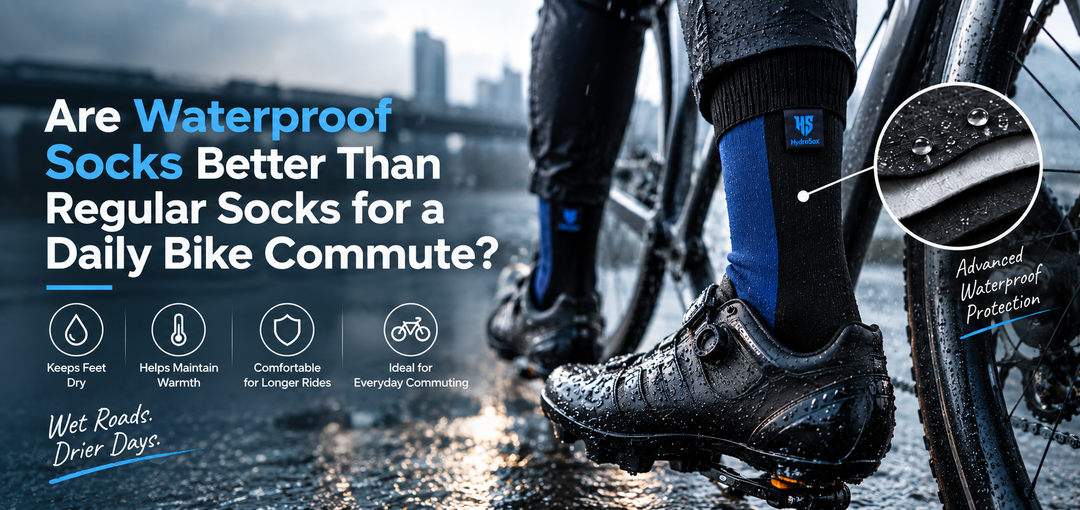
A waterproof sock is three layers, each doing one job. Only the middle layer is waterproof, and it never touches your skin.
It is the same idea as any waterproof, breathable fabric used in a rain jacket, knitted small so it stretches with your foot and fits inside a shoe.
The result is a sock that keeps water out while still feeling like something you would happily ride in every day.
The Layer That Keeps Water Out
The middle layer is a thin sealed film with holes far too small for a drop of liquid water, yet large enough for water vapour to pass through.
So road spray and rain stay outside while the sweat your foot makes drifts out as vapour. Because it is sealed all the way around, the barrier wraps the whole foot.
The Layer That Keeps You Comfortable
Against your foot sits a soft knit that moves sweat toward the membrane and keeps the barrier off your skin.
This is the layer that makes a waterproof sock feel like an ordinary sock rather than plastic, which matters on a ride you do every day.
The Layer That Takes the Wear
The outer knit is the wear surface. It takes the rubbing inside your shoe so the thin membrane does not have to, and it holds the sock in shape wash after wash.
On a sock you pull on every working day, that durability is what keeps a good pair going for a whole winter.
|
What matters |
Regular bike socks |
Waterproof socks |
|
Keeps water out |
No |
Yes, below the cuff |
|
Warm when wet |
No |
Yes, and adds warmth |
|
Breathable at pace |
Yes |
Yes, a little less |
|
Bulk in the shoe |
Low |
Slightly higher |
|
Best for |
Dry rides |
Wet commutes |
Waterproof Socks vs Overshoes for Commuters

Most cycling advice reaches for overshoes. They work, but for a daily commuter they are a faff, and they solve a slightly different problem.
Overshoes protect the shoe from the outside. Waterproof socks protect the foot from the inside, which is what you actually care about when there is nowhere to dry off.
Socks are also simpler to live with. You pull them on with the rest of your kit, ride in your normal shoes, and there is no wet neoprene shell to peel off and store.
Overshoes still win for racing or very long, cold road rides, where they cut wind over the whole shoe. For a stop-start commute, a sock is the easier daily habit.
There is also the cost angle. A pair of socks that works in any shoe is often cheaper than dedicated overshoes that only fit one pair of cleats.
What to Look For in Commuter Bike Socks
Once you know how the layers work, choosing gets simpler. You buy on the barrier and the fit, not the logo.
The best bike socks for a wet commute tend to share a few honest signals:
-
A named membrane you can look up, not a vague waterproof badge
-
A cuff height that clears the ankle, where road spray hits hardest
-
A thickness that still fits your shoe, checked before the first wet ride
-
Limits stated in writing, so you know where the sock stops
Cuff height is a personal call. Some riders want long bike socks that sit high under the calf, others prefer a lower crew that disappears under trousers.
These are the cycling socks UK commuters reach for once the clocks change, because a British winter is mostly wet roads rather than deep snow.
Ignore the marketing words and check the barrier, the cuff and the fit. The best bike socks for commuting get all three right without being flashy about it.
|
Your ride |
Reach for |
|
Dry summer commute |
Thin regular road bike socks |
|
Wet winter commute |
Waterproof bike socks |
|
Cold, wet, long ride |
Waterproof socks with a thin liner |
|
Racing or fast group ride |
Thin socks, plus overshoes if wet |
Warmth, Sweat and the High-Pace Problem
Staying dry is a big part of staying warm on a bike. The membrane also traps a thin layer of still air and blocks the wind that chills wet feet at speed.
The honest limit is breathability at a hard pace. The membrane lets sweat out as vapour, but push flat out in mild weather and you can sweat faster than it clears.
For most commutes that never becomes a problem, because you are riding steady rather than racing. It is worth knowing before a hot, hard effort, though.
If you run warm, a thinner waterproof sock keeps the barrier without much bulk. If you run cold, a slightly thicker one, or a thin liner underneath, adds insulation.
Steady effort is the sweet spot. On a commute you are rarely at your limit, so the membrane keeps up with the sweat you actually produce.
What Waterproof Socks Will Not Do
A waterproof sock is a dry, warmer layer, not a race sock, and it has clear edges worth knowing before you buy.
They are not the lightest, coolest option for a dry summer sprint. On a hot, dry ride a thin sock will always feel faster and airier.
Water still comes in over the top. Ride through standing water deep enough to top the cuff and the sock fills, the same as any sock would.
The extra thickness can change a snug shoe. If your cycling shoes are already tight with thin socks, a waterproof pair may need a little more room.
None of this makes them a bad buy. It makes them a wet-weather tool, brilliant in the rain and simply unnecessary on a dry summer morning.
Getting the Fit Right for Cycling Shoes
Fit is where a waterproof sock lives or dies on a bike. Too small and it stretches thin over the toes, which is where the membrane cracks first.
Size on foot length, not shoe size, because shoe sizing is not consistent between brands. Then check the sock in your actual cycling shoe before a wet ride.
If you land between two bands, go up. A little room keeps the membrane relaxed, and a roomier shoe setting makes space for the slightly thicker sock.
It helps to try the sock and shoe together at home first. Better to find a tight fit on the sofa than a mile into a cold, wet ride.
Keeping Your Commuter Socks Working
A membrane sock only stays waterproof if it is air dried rather than tumble dried. The routine is short and hard to get wrong.
Wash them inside out with no fabric softener, then hang them to air dry. Softener clogs the membrane and dryer heat can peel it.
Because they air dry rather than tumble dry, most daily riders keep two pairs so one is always ready for the next wet morning.
Store them dry between rides and they will not smell. A damp sock stuffed in a pannier is the one that turns musty by the weekend.
Final Thoughts
For a wet daily commute, waterproof socks beat regular bike socks, because a sealed, breathable membrane keeps road spray out and your feet warmer, right up to the open top of the sock.
The condition that flips it is the weather and the pace. On dry days a thin sock is lighter, and at racing effort any sock can be out-sweated.
For steady wet-winter riding with nowhere to dry off, dry feet are worth the small trade in bulk. Check the fit in your shoe, then choose your size.
Fix your feet and winter riding gets a lot easier. The rain still comes, but arriving with dry, warm feet changes how the whole commute feels.
Stay Comfortable on Your Next Wet Bike Commute
Thin cycling socks can work well in dry weather, but wet commutes can quickly leave your feet cold and uncomfortable. HydroSox waterproof socks are designed to help keep road spray out while keeping your feet warmer, without the hassle of removing overshoes when you arrive at the office.
Learn how HydroSox handles road spray and wet winter commutes, then check the fit in your shoe and shop HydroSox waterproof socks in your preferred size.