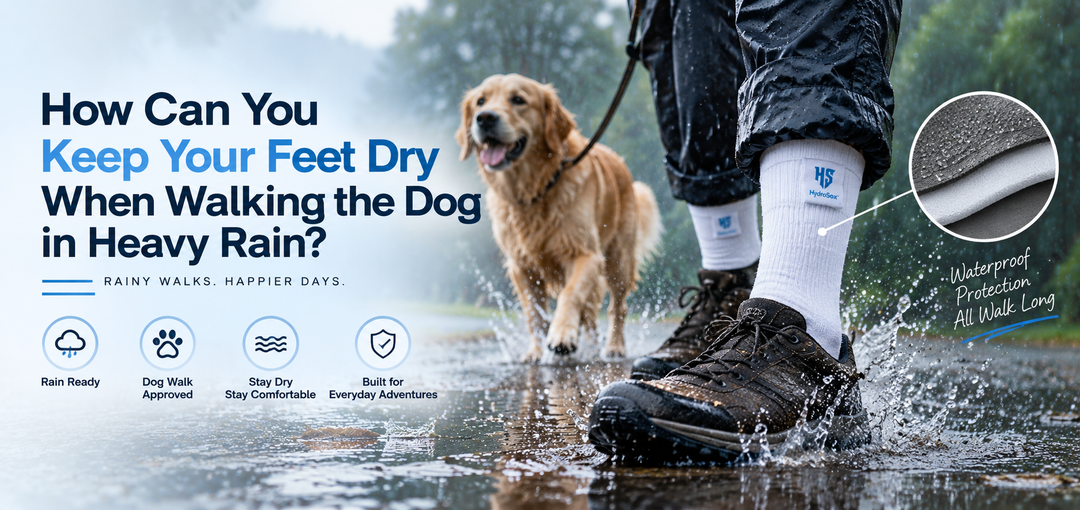
The dog does not check the forecast. Rain or not, twice a day, you are out on the same wet field while everyone else stays indoors.
You pulled on your wellies, sure your feet would stay dry. Half an hour later they are clammy, or cold, or both, and the walk still has twenty minutes left.
Heavy rain and long walks are exactly where ordinary socks and even good boots quietly give up. The fix is smaller and cheaper than a new pair of wellies.
Here is what actually decides whether your feet stay dry on a wet walk:
-
Whether the sock has a real waterproof barrier or just soaks and holds water
-
Whether it stays dry inside a boot that is sweating or leaking
-
How high it sits, since water gets in over the top
-
Whether it keeps you warm when the wind picks up
Do Dog Walker Socks Really Keep Your Feet Dry in Heavy Rain?
Yes. The best dog walker socks seal a thin membrane inside the knit that blocks rain, puddles and wet ground while letting sweat escape as vapour. That works whether you walk in wellies, work boots or trainers, because the barrier is in the sock, not the footwear. The one thing to know is that a sock is open at the top, so water deeper than the cuff runs straight in. Below that line, a good pair keeps your feet dry long after your boots have soaked through, which on a heavy rain walk usually happens sooner than you would like.
Why the Dog Walk Is Harder on Feet Than It Looks
A dog walk sounds gentle, but it is one of the harshest tests a sock faces. It is wet, it is repeated, and there is no drying time in between.
You go out in all weathers because the dog needs it, not because conditions are good. That means soaked grass, flooded gateways and mud that never fully dries.
And you do it twice a day. A pair that dries slowly never catches up, so by the evening walk you are pulling on socks still damp from the morning.
Add a long enough wet spell and rubbing turns into blisters, a miserable way to end a walk you had no choice about taking.
This is why dog walkers feel wet feet more than most. It is not one soaking, it is a hundred small ones with no time to recover between them.
Why Wellies Alone Do Not Keep Your Feet Dry
Everyone assumes wellington boots solve wet feet on their own. They keep rain off the outside, and for a while that is enough.
The trouble is what happens inside. Rubber does not breathe, so your feet sweat, and that sweat has nowhere to go. You come home with damp feet that never touched a puddle.
Water also runs in over the top. On a heavy rain walk it drips off your coat and down your leg, straight into the boot.
And wellies age. Seams crack, the flex point at the ankle wears, and a boot that was dry last winter starts letting water through this one.
None of that is a fault in the boot. A welly is a rubber shell, and a rubber shell will always trap what your feet give off.
Welly Socks, Wellington Socks and Where They Fall Short

So people reach for welly socks. Thick, fleecy, warm, and genuinely lovely on a cold morning. They are built to add comfort inside a roomy boot.
The catch is that welly socks and wellington socks are made for warmth, not waterproofing. They have no barrier, so once water gets in, they soak it up and hold it.
They also slip. A tall thermal sock inside a smooth rubber boot tends to work its way down, bunching under your arch by the second field.
Warm is not the same as dry. A warm sock full of water is still a wet sock, and that is where a membrane changes the job entirely.
There is a place for them, of course. On a dry, cold walk a thick warm sock is exactly what you want, and dryness never becomes the problem.
How Waterproof Socks Solve the Dog Walk
A waterproof sock is three layers, each doing one job. Only the middle layer is waterproof, and it never touches your skin.
It is the same idea as any waterproof, breathable fabric used in coats and boots, knitted small so it stretches with your foot and grips inside a boot.
The Layer That Keeps Water Out
The middle layer is a thin sealed film with holes far too small for a drop of liquid water, yet large enough for water vapour to pass through.
So rain and mud stay outside while the sweat your foot makes drifts out as vapour. Because it is sealed all the way around, the barrier wraps the whole foot.
The Layer That Keeps You Comfortable
Against your foot sits a soft knit that moves sweat toward the membrane and keeps the barrier off your skin.
This is the layer that makes the sock feel normal rather than plastic, and a proper cuff is what keeps it from slipping down inside a boot.
The Layer That Takes the Wear
The outer knit is the wear surface. It takes the rubbing inside a boot so the thin membrane does not have to, and it holds the sock in shape wash after wash.
It is also what lets the sock survive being pulled on and off twice a day through a long, wet winter.
|
What matters |
Welly socks |
Wellington socks |
Waterproof socks |
|
Keeps water out |
No |
No |
Yes, below the cuff |
|
Warm when wet |
Yes |
Yes |
Yes, adds warmth |
|
Stays put in a boot |
Sometimes |
Sometimes |
Yes, gripping cuff |
|
Best for |
Dry cold days |
Dry cold days |
Wet, rainy walks |
What Makes a Good Pair of Dog Walker Socks?
Once you know how the layers work, choosing gets simpler. You stop buying on thickness and start buying on the barrier.
Good dog walker socks tend to share a few honest signals:
-
A named membrane you can look up, not a vague waterproof badge
-
A cuff that grips, so it stays up through a two-field walk
-
Limits stated in writing, so you know where the sock stops
-
A price that reflects the sock, not a whole range of country clothing
The best dog walker socks feel like a normal sock on, which matters when you are pulling them on in the dark before a six o'clock walk.
They also work across footwear. The same pair goes inside wellies for the muddy field and inside trainers for the pavement loop.
Colour barely matters on a muddy walk, but a sock that survives the mud does. Durability is the quiet feature you notice only when a cheap pair of dog walker socks fails.
|
Your walk |
Reach for |
|
Heavy rain, muddy field |
Waterproof dog walker socks in wellies |
|
Cold and dry |
Warm welly socks or wellington socks |
|
Wet pavement in trainers |
Waterproof socks, no wellies needed |
|
Long, cold, wet walk |
Waterproof socks with a thin warm liner |
Waterproof Socks or New Wellies: Which Fix?

When feet keep ending up wet, the instinct is to buy better wellies. Sometimes that is right, but often it is the expensive answer to the wrong problem.
If your boots leak at a cracked seam or a worn ankle, new wellies help. If your feet are wet from sweat and condensation inside, no boot will fix that.
A waterproof sock covers both cases. It keeps your feet dry inside a leaky old boot and inside a brand new one, for a fraction of the price.
So the honest order is socks first, boots later. Try the cheap fix before you replace footwear that might have been fine all along.
Warm and Dry on a Cold, Wet Walk
Staying dry is half of staying warm. Wet skin loses heat fast, which is a big part of how your feet lose heat on a raw January morning.
A membrane traps a thin layer of still air, so it adds a little warmth of its own, and it blocks the wind that chills a boot from the outside.
No one wants cold socks an hour into a walk. Keeping the water out is the surest way to keep the cold out with it.
For the coldest, wettest days, a thin warm sock under the membrane gives you insulation and a barrier together. Warm socks first, dry feet on top.
Dry feet also feel warmer than they are, because your body stops fighting the chill of damp skin and can hold onto its heat.
What Waterproof Socks Will Not Do
A waterproof sock is a dry layer, not a whole outfit, and it has clear edges worth knowing.
They will not replace grippy wellies. On slick mud you still need a sole that bites, and a sock adds no grip or ankle support.
Water still comes in over the top. Wade through a flooded gateway deeper than the sock and it fills, the same as any sock would.
You can still get sweaty feet if you march hard. The membrane slows sweat down, it does not switch it off, so a fast walk in mild weather will still dampen the inside.
After the Walk: Drying Off That Keeps Them Working
A membrane sock only stays waterproof if it is air dried between walks. The routine is short and forgiving.
Rinse off mud before it dries, because caked grit is abrasive and works into the knit every time the sock flexes.
Wash them inside out with no fabric softener, then hang them to air dry. Softener clogs the membrane and dryer heat can peel it.
Because they air dry rather than tumble dry, most dog walkers keep two pairs so one is always ready for the next wet walk.
Store them dry and they will not smell. A damp sock balled up in a coat pocket is the one that turns musty by the weekend.
Getting the Size Right for Boots and Wellies
Fit matters more inside a boot than most people think. Too small and the sock stretches thin over the toes, which is where the membrane cracks first.
Size on foot length, not shoe size, because shoe sizing is not consistent between brands. Stand on paper, mark your longest toe, and measure from the heel.
If you land between two bands, go up. A little room keeps the membrane relaxed and lets the sock sit properly inside a roomy welly.
Room also helps if you layer a thin sock underneath on cold days. A pair sized with no give leaves nowhere for that extra layer to go.
Final Thoughts
You keep your feet dry on a wet dog walk with a sealed, breathable membrane that blocks rain and lets sweat out, right up to the open top of the sock.
The condition that flips the result is depth. Stay below the cuff and your feet stay dry, wade deeper and any sock fills.
Wellies keep the rain off, welly socks keep you warm, and a waterproof sock is the layer that keeps you dry once the boot gives up. For a twice-daily walk in real weather, that is the piece most people are missing.
Fix your feet and the walk changes. The dog still drags you out in the rain, but you stop dreading the state of your feet when you get home.
Try HydroSox for Wet Dog Walks
Your dog does not care about the forecast, so twice a day you are out in it while your feet pay the price. Rain soaks through, mud gets everywhere, and you finish the walk cold and squelching. HydroSox fixes the part you can control.
It is one honest three-layer sock that keeps your feet dry in wellies or trainers, through soaked fields and heavy rain. Pick your colour and size and shop HydroSox waterproof socks before the next downpour.