It is half past eight, it is raining, and you are already late. You cross one wet pavement, step off one flooded kerb, and your feet are soaked before the day has started.
You were wearing your favourite everyday wool socks, the warm ones, and they did their job right up until the water arrived. Now they are heavy, cold and staying that way for hours.
Warm and dry are not the same problem, and most socks only solve one of them. That gap is exactly where a waterproof sock fits into an ordinary week.
Here is what actually decides whether your feet stay dry on everyday outings:
-
Whether the sock has a real waterproof barrier or just soaks and holds water
-
Whether it can still let sweat out so it does not feel clammy
-
How high it sits, since water gets in over the top
-
Whether it is comfortable enough to wear all day, every day
Everyday Wool Socks vs Waterproof Socks: What Actually Keeps Feet Dry?
Everyday wool socks keep your feet warm, even when they get wet, but they cannot keep water out. Waterproof socks do the opposite job, sealing a thin membrane inside the knit that blocks rain and puddles while letting sweat escape as vapour. For dry, cold days, warm wool socks are lovely and hard to beat. The moment the ground is wet, on the school run, the dog walk or the walk to the station, a membrane is what actually keeps your feet dry. Below the open top of the sock, it keeps working long after your shoes have soaked through.
Why Everyday Wool Socks Leave You With Wet Feet
A wool sock is built for warmth, not waterproofing. merino wool and other natural fibres are brilliant at holding heat, which is why so many people reach for them.
The catch is that wool has no barrier. Rain and puddle water soak straight into it, and while it stays warmer than cotton when wet, it is still wet against your skin.
So your warm everyday socks keep your feet from going cold quickly, but they do nothing to stop the water arriving in the first place.
That is the whole distinction. Warmth is one job, and keeping liquid water out is a completely different one that needs a completely different layer.
The Real Cost of Wet Feet on Everyday Outings
Wet feet are not just unpleasant. On a normal day out they quietly cost you comfort, warmth and sometimes skin.
Damp skin softens and rubs, and a short walk can turn into blisters you feel for days. That is a lot of grief from one puddle.
Cold follows close behind. Once your everyday wool socks are soaked, wet fabric pulls heat away fast, so a mild morning starts to feel bitter before you are home.
Then there is the drying. Soaked shoes and socks sit by the door all day, still damp when you need them again for the afternoon walk.
How Waterproof Socks Keep Feet Dry on Everyday Outings
A waterproof sock is three layers, each doing one job. Only the middle layer is waterproof, and it never touches your skin.
It is the same three-layer idea behind waterproof jackets, shrunk to sock size and knitted so it stretches with your foot.
That build is what lets it keep water out without feeling like a bag on your foot, which is where the old plastic tricks always failed.
The Layer That Keeps Water Out
The middle layer is a thin sealed film with holes far too small for a drop of liquid water, yet large enough for water vapour to pass through.
So rain, puddles and wet grass stay outside, while the sweat your foot makes drifts out the other way as vapour. Liquid in, vapour out.
Because the film is sealed all the way around, protection wraps the whole foot, not just the sole. There is no seam for water to sneak through.
The Layer That Keeps You Comfortable
Against your foot sits a soft knit that moves sweat toward the membrane and keeps the barrier off your skin.
This is the layer that makes a waterproof sock feel like an ordinary sock. Get it right and daily wear is genuinely comfortable, not a chore.
The Layer That Takes the Wear
The outer knit is the wear surface. It takes the rubbing inside your shoe so the thin membrane does not have to, and it holds the sock in shape wash after wash.
It is the reason a good everyday pair survives daily use rather than lasting a fortnight.
|
What matters |
Everyday wool socks |
Waterproof socks |
|
Keeps water out |
No |
Yes, below the cuff |
|
Warm when wet |
Yes |
Yes, and adds a little warmth |
|
Lets sweat out |
Yes |
Yes, as vapour |
|
Best for |
Dry, cold days |
Wet everyday outings |
Where They Earn Their Place in an Ordinary Week

Waterproof socks are not a special-occasion item. They earn their keep in the small, repeated outings where wet feet quietly ruin a morning.
The patterns are familiar to anyone who lives somewhere with real weather:
-
The rainy school run, there and back, twice a day
-
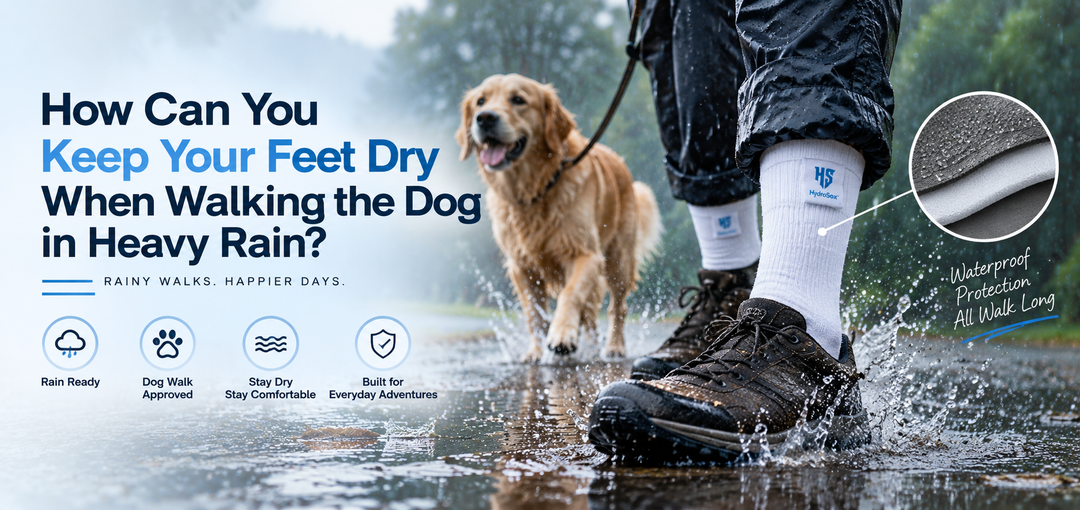
The twice-daily dog walk across long days on wet ground and soaked grass
-
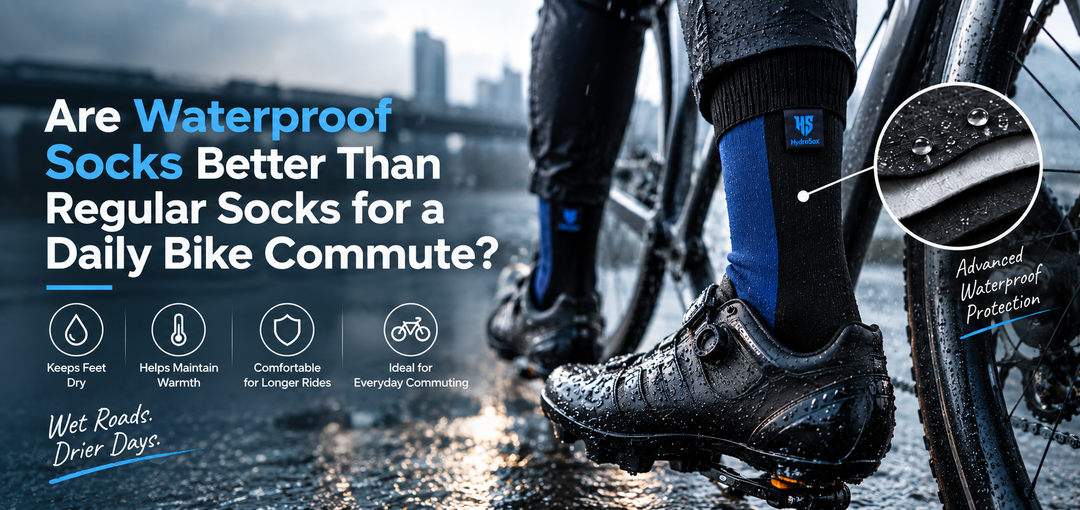
The walk or cycle to the station, with no chance to dry off at the other end
-
Gardening, the allotment, or standing on the sidelines at kids' sport
None of these are adventures. They are just life outdoors in the rain, and they are exactly where a membrane turns a wet morning into a normal one.
This is also why one crew-height pair handles most of a week. The same sock that covers the dog walk covers the commute and the school run.
The common thread is repetition. It is not one big soaking, it is the same wet twenty minutes, twice a day, five days a week.
That is why keeping one pair dry and ready matters as much as the sock itself. Air dried overnight, it is waiting by the door for the morning.
Warm and Dry: Can You Have Both?

You mostly can. A membrane traps a thin layer of still air, so it adds a little warmth of its own on top of keeping your feet warm.
If you want more, a thin wool liner underneath gives you warmth and a barrier together, which is a tidy answer on the coldest wet days.
The honest rule is to match the sock to the outing. Wet and cold calls for the membrane, dry and cold is where your wool casual socks still shine.
Think of it as two tools rather than a contest. One keeps you warm, one keeps you dry, and the weather tells you which to reach for.
The membrane also blocks wind, which on an exposed walk is half the reason your feet feel cold in the first place.
|
The outing |
Reach for |
|
Dry, cold morning |
Warm wool everyday socks |
|
Rainy school run or dog walk |
Waterproof socks |
|
Cold and wet all day |
Waterproof socks with a thin wool liner |
|
Warm, dry day |
Any light everyday sock |
What to Look For in an Everyday Waterproof Sock
Not every pair is built for daily wear. A sock you pull on every morning has to be comfortable, honest and easy to live with.
A few signals separate an everyday pair from a novelty one:
-
A named membrane you can look up, not a vague waterproof badge
-
Crew height that clears the ankle and sits under trousers
-
Limits stated in writing, so you know where the sock stops
-
A price that reflects the sock, not a shop full of extras
Comfort is the quiet decider. The best everyday sock is the one you forget you are wearing, warm socks or waterproof.
Get those right and the sock stops being kit and starts being part of getting dressed.
Waterproof Socks or Waterproof Boots for Everyday Use?
For everyday outings, most people do not want to buy special boots. That is where a sock has an obvious edge.
You keep wearing the trainers, work shoes or wellies you already own, and let the sock do the waterproofing from the inside.
It also means one pair moves between outfits. The same socks go under boots for the dog walk and under shoes for the commute.
Boots still have their place on rough or deep ground. For a normal wet week, though, a sock is the cheaper and more flexible fix.
It is also less to carry and less to store. One pair of socks slips in a bag far more easily than a spare pair of boots.
What Waterproof Socks Will Not Do
A waterproof sock is a dry layer, not a warm blanket, and it has clear edges worth knowing before you buy.
They will not replace your warm socks on a dry, cold day. If there is no water about, wool is softer, warmer for its weight and simply nicer.
Water still comes in over the top. Step into a puddle deeper than the sock and it fills up, the same as any sock would.
You can still get sweaty feet if you push hard. The membrane slows sweat down, it does not switch it off, so a fast effort in mild weather will still dampen the inside.
Do You Still Need Your Wool Socks?
Yes, and you should keep them. This is not a case of one sock replacing another, it is a case of owning the right one for the day.
On dry, cold mornings your everyday wool socks win on comfort and warmth. There is nothing a membrane adds when there is no water to keep out.
On wet days the roles swap. The membrane keeps your feet dry, and wet-day comfort beats dry-day softness every time your feet are soaked.
Keep both in the drawer and let the forecast choose. That is the least fussy way to have warm socks and dry feet without buying one clever pair that claims to do everything.
There is also the simple pleasure of a warm, soft sock on a dry day. A membrane is a tool, and wool is a comfort, and there is room in a drawer for both.
Sizing and Care for Everyday Wear
For daily wear, fit matters more than you would think. Size on foot length, not shoe size, because shoe sizing is not consistent between brands.
If you fall between two bands, go up. A slightly roomier sock keeps the membrane relaxed and lasts far longer than one stretched thin over the toes.
Care is quick. Kept air dried rather than tumble dried, with no fabric softener, a good pair lasts through a lot of wet mornings.
Two pairs is the common everyday setup. One is drying while the other is on your feet, so a wet run of days never catches you out.
Final Thoughts
Warm and dry are two different jobs. Everyday wool socks handle the warmth, and a sealed membrane handles the water, right up to the open top of the sock.
The condition that decides which you reach for is simple: is the ground wet? If it is, the membrane wins, and if it is dry, your wool socks do.
Own both, choose by the weather, and the wet-footed school run stops being part of your week.
Dry feet are a small thing that changes a whole morning. Fix them once and you stop noticing the rain at all.
Buy HydroSox Waterproof Socks for Every Wet Day Out
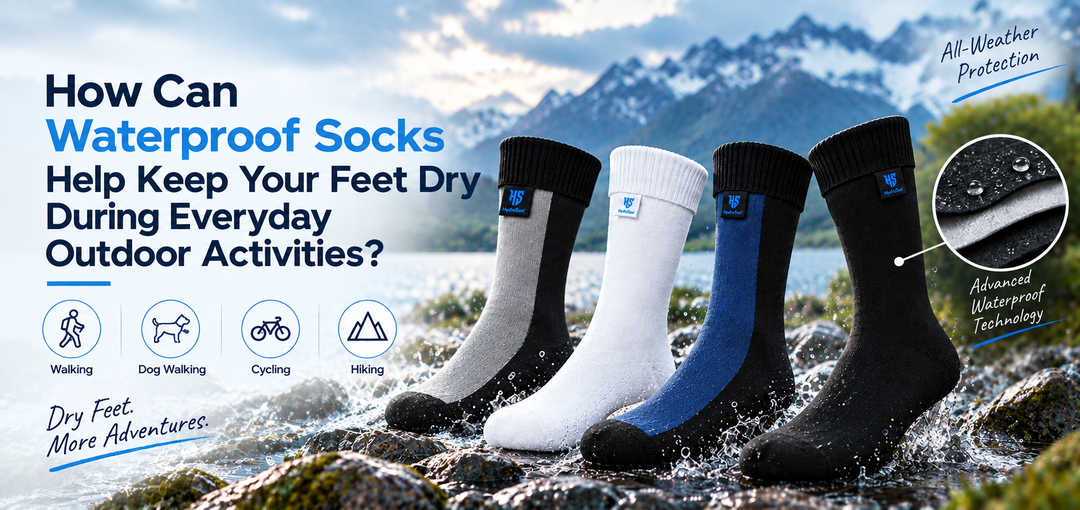
The school run, the dog walk, or a walk to the shops in the rain, these are the everyday outdoor activities where wet feet can quickly ruin your day. HydroSox waterproof socks keep your feet dry through all of them.
Since sizing is based on foot length rather than shoe size, check the HydroSox size guide first to find the right fit. Once you know your size, shop HydroSox waterproof socks and stay comfortable through whatever the day brings.