You know the feeling before you look down. The cold patch spreads across your toes, your sock goes heavy, and you still have three miles or two hours to go.
Rain got through your shoes, soaked your cotton socks, and now every step squelches. By the time you are dry, the damage to your mood is done.
This is the exact problem waterproof socks were built to fix. Not a gimmick, and not magic, but a specific piece of engineering aimed at one job.
Before you buy waterproof socks, it helps to know what the best waterproof socks actually are, and where they quietly stop working. Here is what decides whether a pair keeps you dry:
-
Whether the waterproof layer is a real sealed membrane or a coating
-
Whether that layer can still let sweat out
-
How high the sock sits, since water gets in over the top
-
How well it survives washing and the inside of your boot
How Do the Best Waterproof Socks Keep Your Feet Dry?
The best waterproof socks keep your feet dry with a thin membrane sealed inside the knit that blocks liquid water while letting sweat escape as vapour. Rain, puddles and wet ground cannot pass through the barrier, so your foot stays dry even when your shoes are soaked. The one thing to know is that a sock is open at the top, so water deeper than the cuff runs straight in. Below that line, a well made pair keeps working long after your boots have given up on you.
Why Ordinary and Plastic Socks Let You Down
A normal cotton sock does the opposite of what you need. It soaks up water like a towel, then holds it against your skin, cold and heavy.
Wet skin softens, rubs, and turns into blisters within a couple of miles. That is not bad luck, it is what happens when a wet sock and a moving foot meet.
People have tried shortcuts for years. The classic is a carrier bag over the foot, and a few cheap pairs are barely more than that.
The trouble with any plastic waterproof socks is simple. They stop water coming in, but they also stop your sweat getting out, so your foot ends up wet from the inside instead.
That is why the old tricks never really worked. A barrier is only useful if it also breathes, and a bag does not.
Wool is the other half of the story. It cannot keep water out, but it stays warm when wet, which is why some liners still use it under a membrane.
How Waterproof Socks Work, Layer by Layer
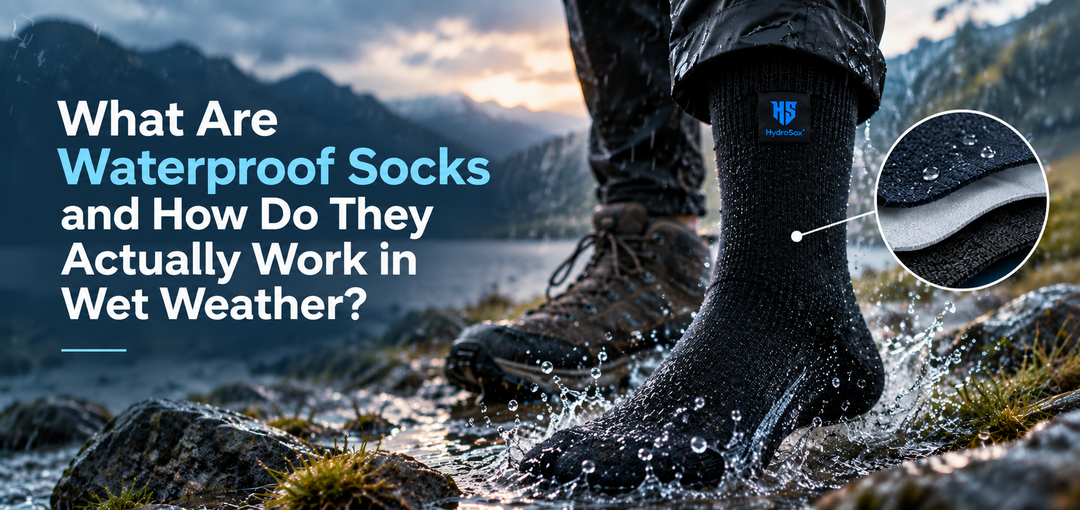
A good waterproof sock is three layers doing three different jobs. Only the middle one is actually waterproof, and it never touches your skin.
Think of it as a sandwich. Two comfortable, hard-wearing knits on the outside, and one clever film in the middle doing the waterproof work.
This is the same idea behind any waterproof, breathable fabric used in jackets and boots, shrunk to sock size and knitted rather than stitched.
The Inner Layer

The layer against your foot is a soft knit that moves sweat outward. It keeps the membrane off your skin, so the sock feels like a sock rather than a bag.
This is the layer that decides comfort. Get it wrong and the sock feels clammy even when it is technically keeping water out.
Cheaper socks skimp here. They press a thin liner against a stiff membrane, and your foot feels every bit of the plastic underneath.
The Waterproof Layer

The middle layer is the whole point. It is a thin film with holes far too small for a drop of liquid water, but large enough for water vapour to pass through.
That is the trick behind breathability. Liquid rain stays out, and the vapour from perspiration drifts out the other way.
The holes are the whole secret. A drop of liquid water is thousands of times bigger than a molecule of water vapour, so one is blocked while the other slips out.
The best waterproof socks name this membrane on the box. If a brand will not tell you what the barrier is, you cannot check the one claim that matters.
A named membrane also means you can read the maker's own limits, rather than trusting a slogan printed by whoever stitched the sock together.
|
Layer |
Its job |
What it means for you |
|
Inner knit |
Wicks sweat, sits on the skin |
Feels like a normal sock, not plastic |
|
Membrane |
Blocks water, passes vapour |
Dry feet in rain, less clammy inside |
|
Outer knit |
Takes wear, holds shape |
Survives the inside of a boot |
The Outer Layer

The outer knit is the wear surface. It takes the constant rubbing inside your boot so the delicate membrane does not have to.
It is also what keeps the sock in shape after a hundred washes. A membrane with no armour around it would not survive a wet British winter.
It is easy to ignore, because you never see it fail directly. But a thin outer knit lets grit reach the membrane, and that is when a good pair suddenly leaks.
This three-layer approach is exactly what HydroSox uses. To see how the knit and membrane fit together, read how the three-layer technology works.
Where Waterproof Socks Earn Their Place
Waterproof socks are not for everyone every day. They earn their keep where wet feet are almost guaranteed and there is nowhere to dry off.
A few patterns come up again and again:
-
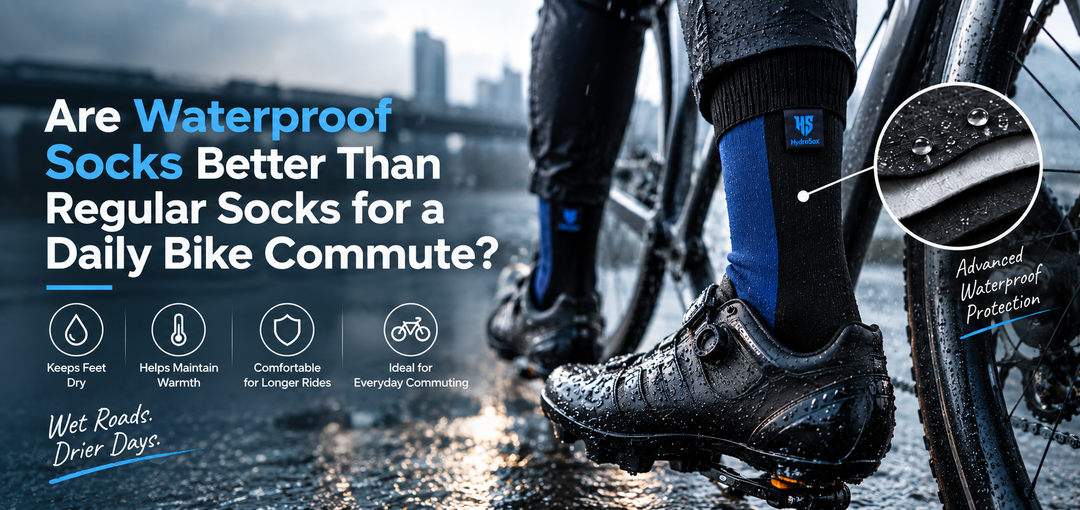
The rainy commute, on foot or by bike, where your shoes are still wet when it is time to head home
-
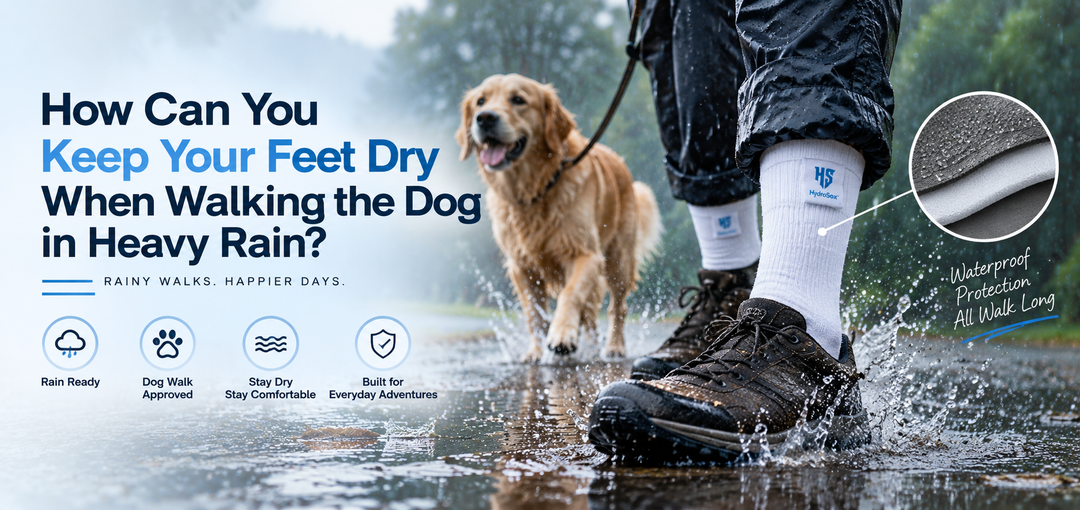
Long dog walks across soaked grass and muddy fields, twice a day, whatever the sky is doing
-
Ten hour shifts in work boots or wellies, five days a week, which is where long shifts in boots and wellies really shows
-
Wet hikes and trail runs, where soggy skin turns into blisters miles from the car
The thread running through all of them is time. A short dash through drizzle barely matters, but hours of wet ground is where a membrane changes your day.
It is also why most people buy two pairs. They air dry rather than tumble dry, so one pair does not always keep up with a genuinely wet week.
Dry feet are not only about comfort. Wet skin pulls heat away quickly, so on a cold day staying dry is also how you stay warm.
What Separates the Best Waterproof Socks From the Rest
Once you understand the layers, buying gets easier. You stop paying for the logo and start paying for the barrier.
Search 100 waterproof socks online and you will find dozens of brands promising the same sealed, dry result. Most of the price gap between them is not the membrane at all.
The best waterproof socks tend to share three honest signals:
-
A named membrane you can look up, not a vague waterproof badge
-
Limits stated in writing, like the fact that water comes in over the top
-
A price that reflects the sock, not a huge range of hats and jackets around it
You will also see pairs sold as 360 waterproof socks, meaning the barrier wraps the whole foot. That is normal for a proper membrane sock, not a special feature to pay extra for.
|
Option |
Keeps rain out |
Lets sweat out |
Good for daily wear |
|
Cotton sock |
No |
Yes |
Only when dry |
|
Plastic bag or coated sock |
Mostly |
No |
No, gets clammy |
|
Membrane waterproof sock |
Yes, below the cuff |
Yes |
Yes |
None of that has to cost forty pounds. A fair price comes from a brand selling one product direct, rather than funding a whole rail of jackets and gloves.
When you compare pairs, ignore the marketing words and check three things: the membrane name, the stated limits, and the return window. The best waterproof socks give you all three without being asked.
That honest checklist is exactly how HydroSox is built: one product, a named Porelle membrane, its limits written in plain English, and a fair price from £20 rather than forty. When you are ready, shop the HydroSox waterproof socks in your colour and size.
Waterproof Socks or Waterproof Boots?
People often treat this as a choice. It is not, because the two solve the problem at different points in the day.
Waterproof boots try to stop water at the outside. That works until the leather wets out, the seams give, or rain runs down your leg and over the top.
A waterproof sock works from the inside instead. Once your boots have soaked through, and on a long wet day that is usually a matter of when, the sock is the layer still keeping your foot dry.
So the honest answer is both, in order. Wear the right footwear for the ground, and treat the sock as the backup that keeps working after the boot gives up.
Getting the Size Right Matters More Than You Think
A waterproof sock lives or dies on fit. Too small and it stretches thin over the toes, which is exactly where the membrane cracks first.
Size on foot length, not shoe size, because shoe sizing is not consistent between brands. Stand on paper, mark your longest toe, and measure from the heel.
HydroSox sizes on foot length across UK 3 to 14 in four bands, so check the HydroSox size guide before you order, and if you fall between two bands, take the larger one.
If you land between two bands, go up rather than down. A slightly roomier sock keeps the membrane relaxed and lasts far longer than one fighting your foot all day.
Comfort matters here too. A sock that grips the toes all day is the one you leave in the drawer, however waterproof it started out.
What Waterproof Socks Will Not Do
Honesty is where most guides go quiet. A waterproof sock is a layer, not a miracle, and it has clear edges.
They will not replace your boots. If your footwear is wrong for the ground, socks will not add grip or ankle support, they only keep your feet dry.
Water still gets in over the top. Step into a puddle deeper than the sock and it fills up, exactly like any other sock would.
You can still get sweaty feet too. Work hard enough and you will out-sweat the membrane, which slows moisture down rather than stopping it entirely.
None of this is a reason to skip them. It is a reason to use them for what they are, a reliable dry layer with an honest ceiling.
They will not last forever either. Toenails, sharp grit and a hot tumble dryer will all finish off a membrane, whatever the brand promised.
HydroSox publishes these limits openly, which is the point, and backs every pair with free UK delivery and a 14-day return window, so trying a pair is low risk.
How to Wash Waterproof Socks So They Keep Working
A membrane sock only stays waterproof if it is washed and dried the right way. The good news is the routine is short.
Wash them inside out on a normal cycle, skip the fabric softener, and let them air dry. Softener clogs the membrane and heat can peel it.
Rinse off mud before it dries, because caked grit is abrasive and works into the knit every time the sock flexes.
Keep your toenails trimmed and shake grit out of your boots. The layer that fails first is almost always the one a sharp edge got to.
Final Thoughts
Waterproof socks work because a sealed, breathable membrane keeps rain out and lets sweat vapour escape, right up to the open top of the sock.
The condition that flips the result is depth. Stay below the cuff and your feet stay dry, go deeper and any sock fills.
Treat them as one honest layer among several. Right boots, right socks, trimmed nails, and most wet days stop being a problem at all.
If you want dry feet on wet days without buying new boots, the best waterproof socks are one of the cheapest upgrades you can make. Check the membrane, check the limits, then choose your size.
Ready for Dry Feet? Try HydroSox Waterproof Socks
You have read how the membrane keeps rain out while letting sweat escape. HydroSox puts that into one honest product: a named Porelle membrane in four colours, sized on foot length across UK 3 to 14, from £20 with free UK delivery and 14-day returns.
When you are ready, shop HydroSox waterproof socks in your preferred colour and size.